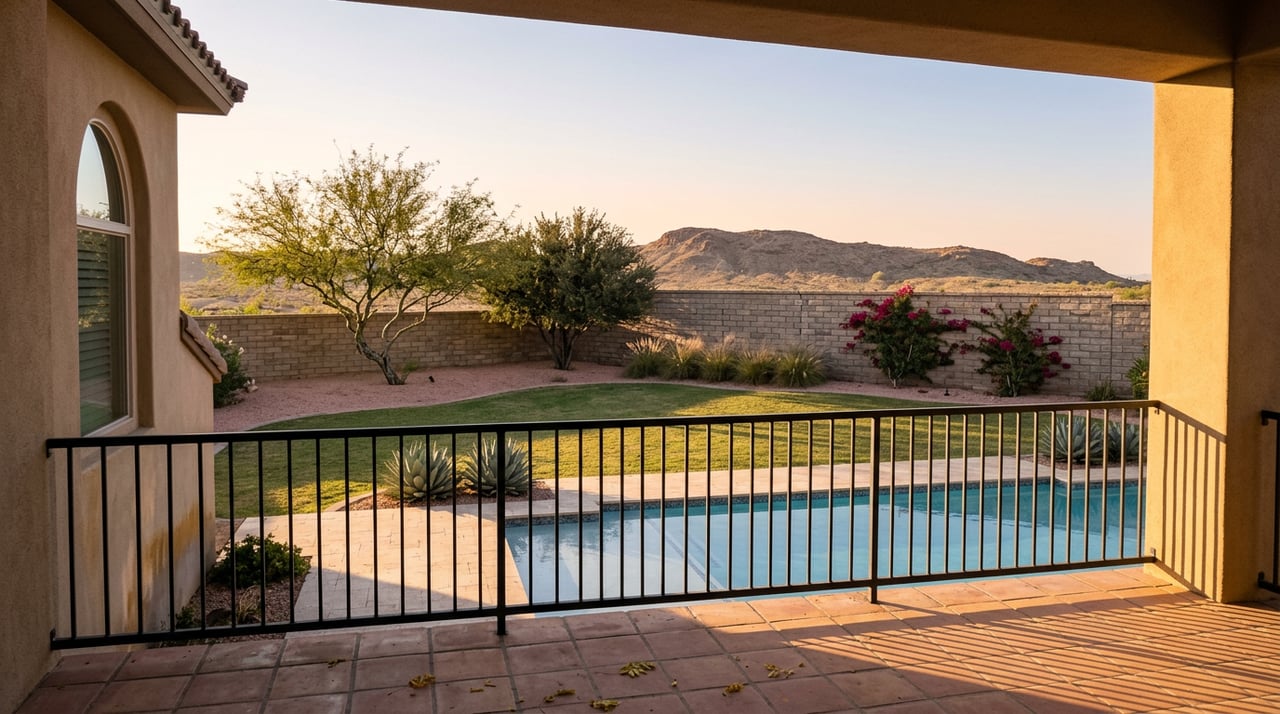
Three hundred fifty seven homeowners in Club West paid a premium of up to $60,000 for a specific promise: a house that backed onto a golf course. Not a house near a golf course. A house that would always back onto a golf course, because the sales materials from the original builder said so, and the deed felt like it said so too.
That promise just lost in Maricopa County Superior Court.
The ruling, handed down by Judge Suzanna Pineda and reported by Ahwatukee Foothills News on February 3, 2026, closed four years of litigation between the Club West Conservancy and the golf course's owner, a company called The Edge. The Conservancy argued the course's governing documents required it to stay a golf course forever. Pineda disagreed, writing that the property owner may proceed "subject only to zoning and applicable regulations." The lot premium bought a view. It did not buy a veto.
If you are comparing homes anywhere in Ahwatukee where the listing photo includes a fairway, a wash, a greenbelt, or any open space you do not own, this ruling is the most useful thing you can read before you write an offer. Not because it tells you Club West is about to fill with houses tomorrow. It probably is not. But because it exposes a mechanism that has nothing to do with golf and everything to do with paperwork most buyers never ask to see.
Two Sets of Rules, and Only One of Them Covers You
Here is the part that surprised even longtime Club West residents. The golf course was never governed by the same CC&Rs as the homes around it. The community's Master CC&Rs cover the houses, the streets, the HOA dues. The golf course sits under its own, separate set of covenants, controlled by whoever holds the declarant rights to that specific parcel. Those rights started with the original developer, passed through Shea Homes, and eventually landed with The Edge.
Pineda's ruling turned on this separation directly. The homeowners, she found, were never parties to the golf course's governing documents and had no standing to enforce them. The course's own paperwork allowed its owner to change the land's use. The neighboring subdivision's paperwork was irrelevant to that question, no matter what the original sales brochures implied.
This is not a Club West quirk. It is how private amenity land is typically structured across master-planned Arizona subdivisions, including newer Ahwatukee developments. The amenity looks like a shared feature. Legally, it is often a private asset with its own owner and its own rulebook, and that rulebook is the only one that matters when the owner decides to sell.
The Timeline That Got Us Here
The course closed in 2016, when former owner Wilson Gee stopped paying the city's potable water bills to irrigate it. Nothing else was viable. The site briefly reopened between late 2017 and early 2018 under a different operator, who also went broke on the same water costs before returning it to Gee.
The Edge bought the 164-acre site from Gee in 2019 for $750,000. Its first plan, floated in 2020, was to sell three parcels to Taylor Morrison for roughly 164 single- and two-story homes, using the proceeds to fund a smaller 18-hole course and a new clubhouse. Homeowners who had paid those premium lot prices objected, largely over the two-story homes blocking views they believed the golf course guaranteed. Taylor Morrison pulled out.
The Club West Conservancy formed and sued in December 2021. Four years of filings, a dismissed Shea Homes claim, a five-day trial, and one 10-page ruling later, The Edge won the right to do largely what it wants with the land.
What Happened Almost Immediately After
Within months of the ruling, The Edge sold the course to a consortium of 15 investors operating as Community Harmony Coalition LLC for $2.1 million, nearly triple what The Edge paid in 2019. By late July 2026, DR Horton had filed pre-application documents with the Phoenix Planning and Development Department proposing up to 573 single-family homes across the roughly 162 to 167 acre site.
That number is not a done deal. City planners flagged a substantial list of hurdles DR Horton has to clear before the project can move to a public hearing:
- A traffic impact analysis built on the maximum home count the builder is proposing, even if that number eventually shrinks
- Review under Phoenix's hillside development regulations, since portions of the parcel sit close to South Mountain
- Early coordination with the city's Hillside Coordinator on how the terrain constrains buildable area
- Consultation with the Water Services Department, given the site's entire history is a water-cost story
- Hearings before the Ahwatukee Foothills Village Planning Committee, the Phoenix Planning Commission, and finally City Council
That is not a fast process. It can realistically run months, and every step is a public hearing where affected homeowners can show up and speak. But the legal question that used to block this path entirely, whether the owner has the right to build houses here at all, is now settled. What remains is a planning fight, not a property-rights fight.
Why the Math Makes This Almost Inevitable
Post-trial filings in the case included a builder's own revenue projection for the site: between $121.9 million and roughly $250 million in total home sales, translating to a profit range of $28.4 million to $48.2 million for the builder, with more than $8 million going to The Edge.
Put that number next to the $60,000 lot premiums that started this whole fight. A handful of view premiums paid by 357 homeowners, even added together, come nowhere close to matching the economics of building hundreds of new homes on 160-plus acres of vacant, centrally located land. That imbalance is the real reason redevelopment fights over dead golf courses keep recurring across the Valley. It is not that developers are especially aggressive. It is that the math on unused land inside an established neighborhood almost always favors building over sitting.
It Is Already Happening Next Door, Without a Lawsuit
You do not need a court case to see this pattern working. West of Club West, the 373-acre Upper Canyon community is under construction right now, with Pulte, DR Horton, and Blandford building toward roughly 1,050 planned homes and model homes opening mid-2026. Pulte's single-story designs start between $659,000 and $696,000, with two-story models running $746,000 to $1.04 million. Those two-story models sit close enough to Club West that they are already expected to change mountain views for some existing homeowners there, no litigation required. A view is only as durable as the land it looks across, whether that land is a golf course under a separate declarant or a stretch of desert zoned for future housing.
What To Actually Check Before You Pay for a View
If you are weighing a home in Club West, Foothills Reserve, or anywhere else in Ahwatukee where the appeal includes adjacent open space, the Club West case points to a short, specific diligence list that most buyers skip entirely:
- Ask who currently holds the declarant rights to the adjacent land and confirm whether that is a separate legal entity from your community's HOA
- Request the recorded CC&Rs for the amenity parcel itself, not just your subdivision's Master CC&Rs, and read what they actually permit
- Check whether the amenity has changed ownership recently or has any pending zoning or pre-application filings with the city
- Treat marketing language about permanent views or guaranteed amenities as a selling point, not a legal guarantee, unless it is written into a recorded document that binds successors
None of this means golf-adjacent or view lots are a bad buy. Many of them remain excellent value and will stay that way for years. It means the premium you pay should be priced with the actual legal protection in mind, not the assumption built into a decades-old sales brochure.
A Few Direct Questions
Does this ruling mean homes are definitely coming to the old Club West course? Not yet. DR Horton's pre-application is an early step and still has to clear hillside development review, a traffic study, and three separate public hearings before any construction could begin.
Does this only apply to golf courses? No. The underlying issue, a shared amenity governed by its own separate CC&Rs rather than the community's Master CC&Rs, applies to private parks, lakes, and open-space parcels in other master-planned communities too.
Should this change how I think about resale value in Club West right now? It is worth factoring into your timeline and your offer, but a 573-home pre-application moving through Phoenix's approval process is a multi-month, public process, not an overnight change to the neighborhood.
If you are comparing Ahwatukee subdivisions and want to understand what a specific lot's view, adjacency, or premium is actually worth once you factor in the paperwork behind it, Arizona Proper Real Estate can walk the declarant rights and recorded CC&Rs with you before you make an offer. Schedule a private consultation and we will pull the documents that actually matter, not just the listing photos.