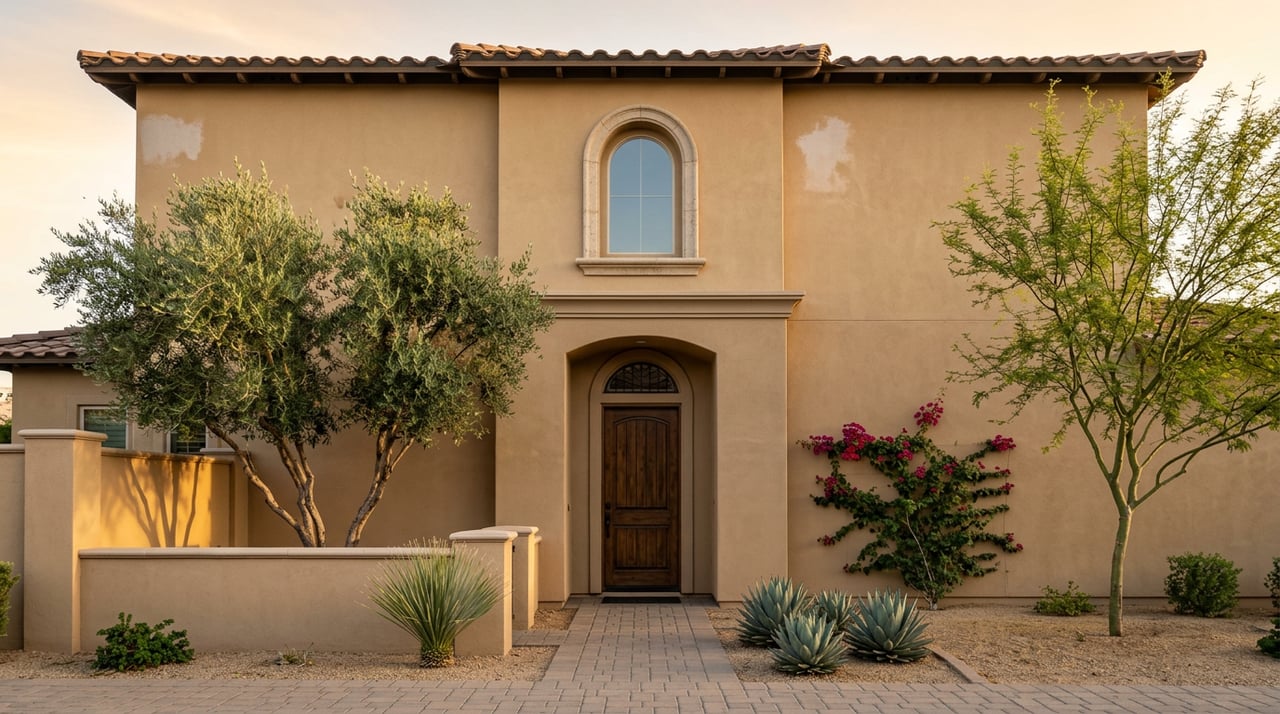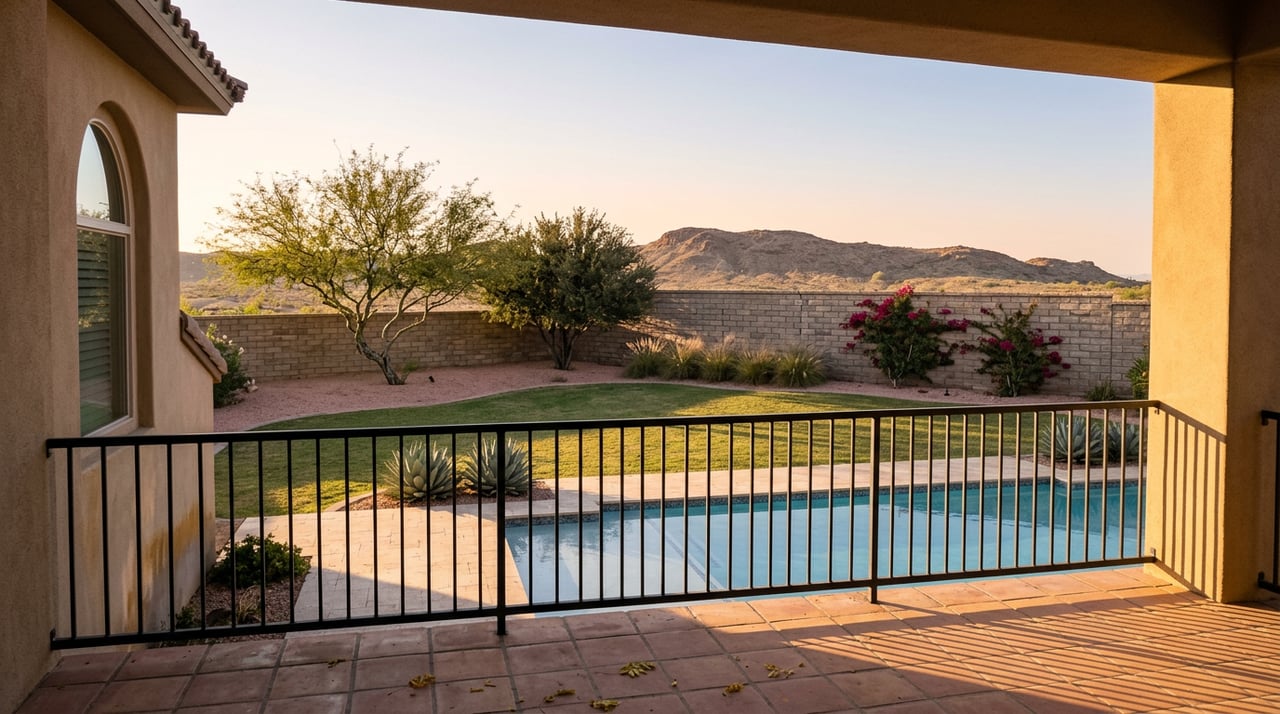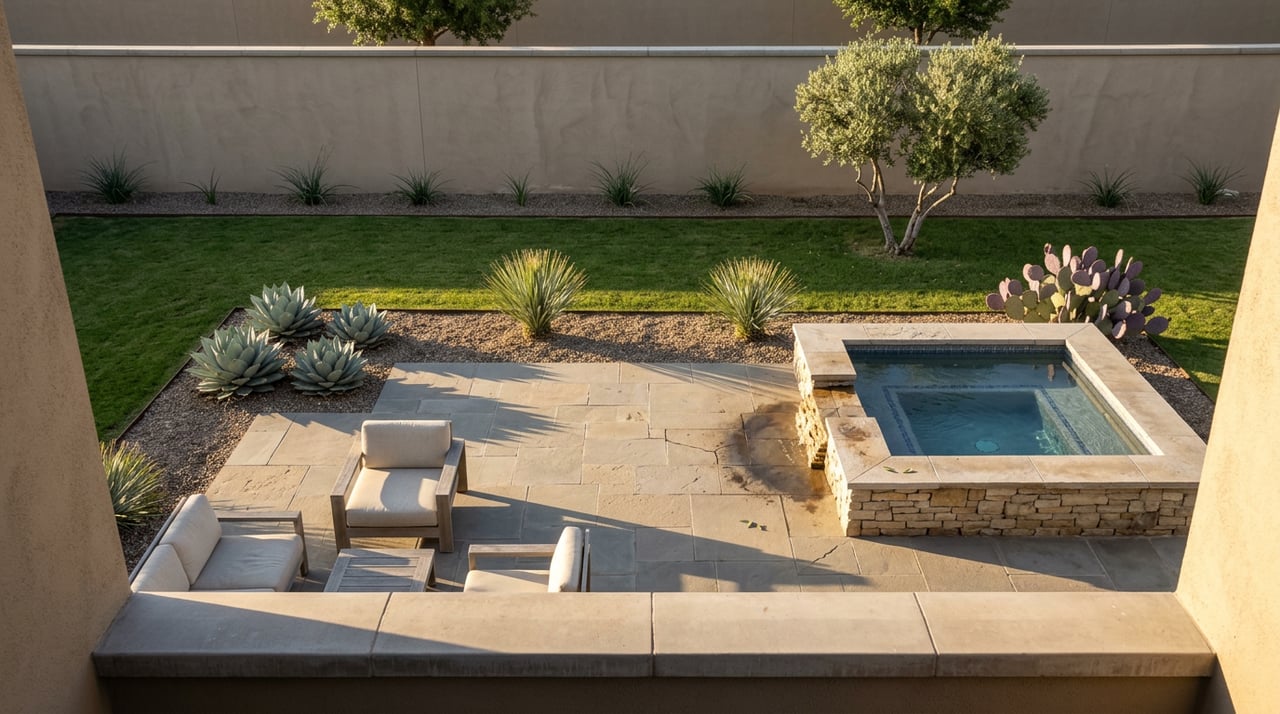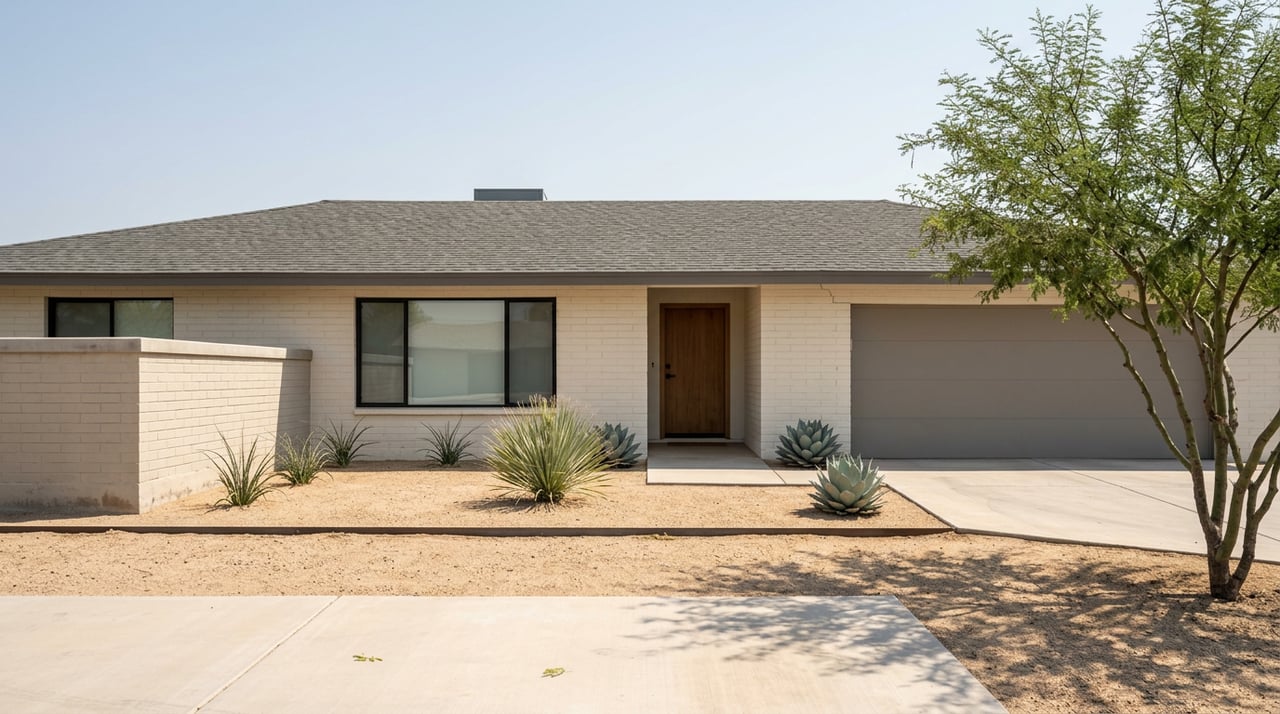
A one-acre lot in Paradise Valley and a one-acre lot in Arcadia sound like they should buy roughly the same amount of house. They don't, and the gap has almost nothing to do with which address sounds more exclusive. It comes down to a floor-area rule written into Paradise Valley's zoning code decades ago, one that caps how much house you're allowed to build no matter how much you're prepared to spend. Read the median prices across Paradise Valley, Arcadia, Biltmore, and Scottsdale as four tiers of the same product, and you'll misread every one of them.
The Rule Nobody Mentions in the Median
Paradise Valley zones the overwhelming majority of its land R-43: low-density residential requiring a minimum of one acre, or 43,560 square feet, per single-family house. That part shows up in most neighborhood guides. What rarely gets mentioned is the floor-area cap that rides along with it. The town limits total floor area to roughly 25 percent of the lot, a rule that holds even on a generous acre-plus parcel. Run the math on a flat one-acre lot and the ceiling lands somewhere in the low five figures of square footage, before garages, covered patios, and other counted spaces start eating into that number.
Add a sloped lot and the math gets stricter still. Paradise Valley routes hillside parcels through a separate Hillside Building Committee before a permit is issued, and the town has left its adopted building code frozen since 2016, so a plan drawn for a neighboring city rarely drops in cleanly. None of this is about finish level. It's a structural ceiling on how much house the ground can legally hold, and it's a large part of why 2026 build costs in Paradise Valley run from roughly $500 to more than $1,000 per square foot, the highest range anywhere in metro Phoenix.
That distinction matters more than it sounds like it should. When you can't add more square footage no matter how large the check, every dollar goes into land, site work, and finish quality per foot you're allowed to build. A $987 per-square-foot median in Paradise Valley in May 2026 (up from $951 in April) isn't proof the town's homes are built better than Arcadia's. It's proof the town's own code makes square footage the scarcest input in the transaction.
A Market That Trades by the Dozen, Not the Hundred
Paradise Valley also closes far fewer sales than its neighbors, which changes what the word "median" is even doing. Scottsdale and Phoenix each close somewhere between 800 and 1,000 single-family homes in a typical month. Paradise Valley closes roughly 40 to 60. That's not a rounding difference. It means a single trophy sale, or the absence of one, can move the reported median by six or seven figures from one month to the next.
That volatility shows up as flat contradiction once you set two sources side by side. As of mid-2026, one widely used home-value index put Paradise Valley's typical home value near $3.0 million, down slightly year over year. A separate rolling three-month figure through April 2026 read closer to $4.6 million, a gap of more than 50 percent between two measurements of the same town in the same season. Neither figure is wrong. Both are measuring the same thin trickle of closings through slightly different windows, and in a market this small, the window you pick decides the number you get.
The town's active inventory tells the same story from a different angle. As of June 2026, Paradise Valley carried 431 single-family listings at a median list price of $5.25 million, a range that ran from a $229,000 teardown lot to multi-acre trophy estates well above that median. A buyer comparing "Paradise Valley's price" to Arcadia's price is often comparing a land parcel priced for its dirt to a renovated ranch home, both filed under the same town.
Same Median, Different House
Arcadia and Biltmore post medians close enough to look interchangeable on a spreadsheet, and that's exactly where the comparison breaks down. In ZIP 85018, June 2026 closings put Arcadia's median sale price at $1,545,000 across 79 transactions, up 1.8 percent year over year, with price per square foot averaging $618. Cash purchases ran close to 34 percent of those deals, nearly double the citywide Phoenix rate. The inventory behind that number is almost entirely non-gated single-family ranch and Spanish Colonial product. Recent notable closings included a $7.85 million new-build estate on Calle Tuberia, a $5.15 million renovated ranch on Exeter Boulevard, and a $3.75 million rebuild on Mountain View Road in Arcadia Proper.
Biltmore's May 2026 closings landed at a median of $1,455,000, up 8.7 percent year over year, with price per square foot at $492. That figure sits inside a footprint of roughly 2,200 homes and condos, and a meaningfully higher share of that inventory is attached product inside guard-gated communities like Biltmore Hillside Villas, where average sale prices of $1,895,000 were lifted by a handful of estate closings on Biltmore Estates Circle. Buyers there are also paying for something Arcadia doesn't offer at all: walking access to the Waldorf Astoria resort, two 18-hole Biltmore Links golf courses, and Biltmore Fashion Park inside the same guard-gated perimeter.
Put those two medians next to each other and they look like variations on one price tier. They're describing two different products. Arcadia's number reflects detached ranch homes on irrigated lots. Biltmore's number reflects a mix that's part single-family estate and part resort-adjacent condo, pulled toward the middle by the condo share.
Scottsdale Isn't One Market
If Paradise Valley's median is thin and Biltmore's is mixed, Scottsdale's is arguably not a single market at all. As of mid-2026, Old Town's condo-and-townhome-heavy inventory carried typical prices from the high $500,000s to the low $800,000s. North Scottsdale, built around golf communities and larger detached lots, carried a median near $1.3 million over that same stretch. A three-month window ending June 2026 put North Scottsdale's median specifically at $1.2 million, with price per square foot near $447. South Scottsdale, sitting between the two, posted a median near $880,000 for single-family homes over the same period.
Those figures barely overlap. A buyer told "Scottsdale's citywide median sits near $950,000" is being handed a number that describes neither Old Town's walkable condo stock nor North Scottsdale's golf-course estates. It describes the midpoint between two markets that happen to share a city name.
What This Means If You're Comparing Neighborhoods
None of this is an argument that one of these four areas is a better buy than another. It's an argument for reading each median as a description of a specific product before you read it as a price. In Paradise Valley, the number you see is shaped by a one-acre zoning floor and a floor-area cap that turns square footage itself into the scarce resource. In Arcadia, it's shaped by a nearly uniform detached-home inventory with real cash-buyer competition. In Biltmore, it's shaped by a mixed condo-and-estate footprint anchored to resort amenities. In Scottsdale, there effectively isn't one number to read.
If you're weighing these four areas against each other, the conversation worth having with an agent isn't "which median is lower." It's "what does this town's zoning code, lot size, and product mix let me actually build or buy for that number." That's a conversation best had neighborhood by neighborhood, not zip code by zip code on a portal.
You can start that comparison directly, with current listing data for Paradise Valley, Arcadia, Biltmore, and Scottsdale, or with a broader view of the Maricopa County luxury corridor as a whole.
A Few Questions Worth Settling Early
Does a higher price per square foot mean a Paradise Valley home is built to a higher standard than one in Arcadia? Not necessarily. Paradise Valley's floor-area cap limits how much square footage a lot can legally support, so the same construction budget spreads across fewer feet. That mechanically pushes the per-square-foot figure up regardless of finish quality.
Why do different sources show different median prices for Paradise Valley in the same season? Paradise Valley closes roughly 40 to 60 single-family sales a month, compared with 800 to 1,000 or more in Scottsdale or Phoenix. With that few transactions, one or two trophy closings can shift the reported median by a wide margin, and different providers pull their numbers from different rolling windows.
Is Arcadia a reasonable substitute if Paradise Valley's entry price is out of reach? It depends on what you're prioritizing. Arcadia offers detached ranch and Spanish Colonial homes on irrigated lots at roughly a third of Paradise Valley's median, but it doesn't carry the one-acre zoning floor or the same degree of privacy that shapes Paradise Valley's built form.
Every one of these four markets rewards a buyer who understands what's actually driving the number, not just the number itself. If you're trying to figure out which Maricopa County luxury corridor fits your budget and your priorities, Arizona Proper Real Estate can walk you through the zoning, the inventory, and the comps neighborhood by neighborhood. Schedule a private consultation to start that conversation.